

Preview
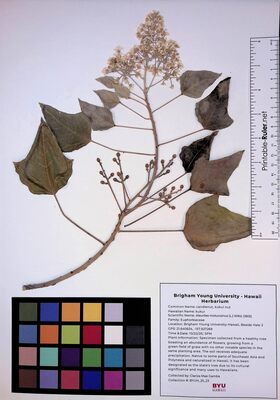
Alternate Name(s)
Candlenut Tree
Scientific Name
Aleurites moluccanus
Class
Magnoliopsida
Order
Malpighiales
Family
Euphorbiaceae
Genus
Aleurites
Status in Hawaii
Naturalized
Native Region
Indo-Malay Region
Cultural Significance
The kukui, or Aleurites moluccanus, is a hardy Polynesian-introduced canoe plant native to the Indo-Malaysia region that became deeply embedded in Hawaiian culture for its beauty, resilience, and wide-ranging uses. Found from sea level to 2,200 feet in moist valleys, streams, and lowland forests across the islands, kukui was intentionally spread and cultivated, notably in places like Hāmākua where groves supported kalo agriculture by providing mulch and nutrients. Nearly every part of the tree was utilized: its soft wood for lightweight canoes and fishnet floats; shells for lei and dye used in kākau (tattooing), kapa, and waʻa; roasted nuts for torches and the condiment ʻinamona; and seed oils for lamps, paint, and fertilizer. Although toxic if improperly prepared, kukui was skillfully transformed into traditional medicines and dyes, reflecting deep ecological knowledge. Today it remains valued in landscaping for its fast growth, silvery foliage, and tolerance of diverse conditions. In ʻōlelo Hawaiʻi, “kukui” also means torch and symbolizes enlightenment and guidance, and the tree is recognized as a kinolau (physical manifestation) of the pig deity Kamapuaʻa, linking it to agricultural fertility and spiritual meaning. In its native range, such as in Asia, the candlenut tree is widely cultivated for its practical uses: people roast and grind the nuts for cooking, use the seeds and bark for traditional medicine, press the oil for hair and skin products, apply the seed cake as fertilizer, and grow special varieties for traditional games and intercropping with crops like coffee in Indonesia.
Sources
An Eye on Plants: Kukui - National Tropical Botanical Garden. (2025, June 26). National Tropical Botanical Garden. https://ntbg.org/stories/an-eye-on-plants-kukui/
Aleurites moluccana | Plant Pono. (2024). Plant Pono. https://plantpono.org/pono-plants/aleurites-moluccana/
Aleurites moluccanus. (n.d.). CIFOR. https://www.cifor.org/feature/energy-from-forests/aleurites-moluccanus/
Collection Date
Fall 10-22-2025
Collection Number
BYUH_25_23
Recommended Citation
Gamba, Clariza Mae Anoc, "Kukui" (2025). Herbarium Collection. 12.
https://digitalcollections.byuh.edu/herbarium/12