

Preview
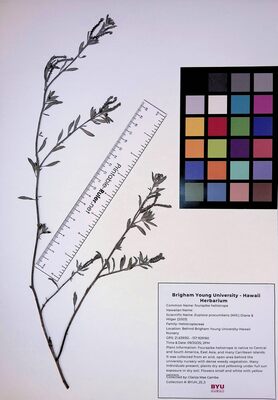
Scientific Name
Euploca procumbens
Class
Magnoliopsida
Order
Boraginales
Family
Heliotropiaceae
Genus
Euploca
Status in Hawaii
Invasive
Native Region
Tropical America, Subtropical America
Cultural Significance
Although direct studies on the medicinal use of E. procumbens are lacking, its cultural significance in its native region is reflected in how local communities interact with and value the plant. Knowledge of related species in the Boraginaceae family—long recognized for their bioactive compounds—has led to its inclusion in herbarium records as a plant of medicinal potential [1]. In semiarid regions of northeastern Brazil, E. procumbens is familiar to residents as a readily available roadside plant used as forage for livestock, contributing to traditional animal-feeding practices and local subsistence systems, even as it is sometimes regarded as a weed [2]. The species also plays an ecological role valued by communities, serving as a pollen source for bees, thereby linking it to pollination, agriculture, and the broader cultural relationship between people, plants, and the landscapes they inhabit [3].
Sources
Heliotropium procumbens: info from PIER (PIER species info). (2025). Hear.org. http://www.hear.org/pier/species/heliotropium_procumbens.htm
[1] DOI https://doi.org/10.1039/NP9941100613
[2] Nunes, E. N., Ribeiro, S., Souza, R. S., Rubens, Dias, D., & Farias, R. (2023). Euploca procumbens (Mill.) Diane & Hilger Boraginaceae. Ethnobotany of Mountain Regions, 393–398. https://doi.org/10.1007/978-3-030-87251-9_45 [3] MATOS, SANTOS, SILVA, C, C. R., & JOSÉ, E. (2017). Boas práticas de manejo apícola. Sidalc.net. https://www.sidalc.net/search/Record/dig-infoteca-e-doc-986110/Description
Collection Date
Fall 9-20-2025
Collection Number
BYUH_25_5
Recommended Citation
Gamba, Clariza Mae Anoc, "Fourspike Heliotrope" (2025). Herbarium Collection. 5.
https://digitalcollections.byuh.edu/herbarium/5